


Components of the Caster
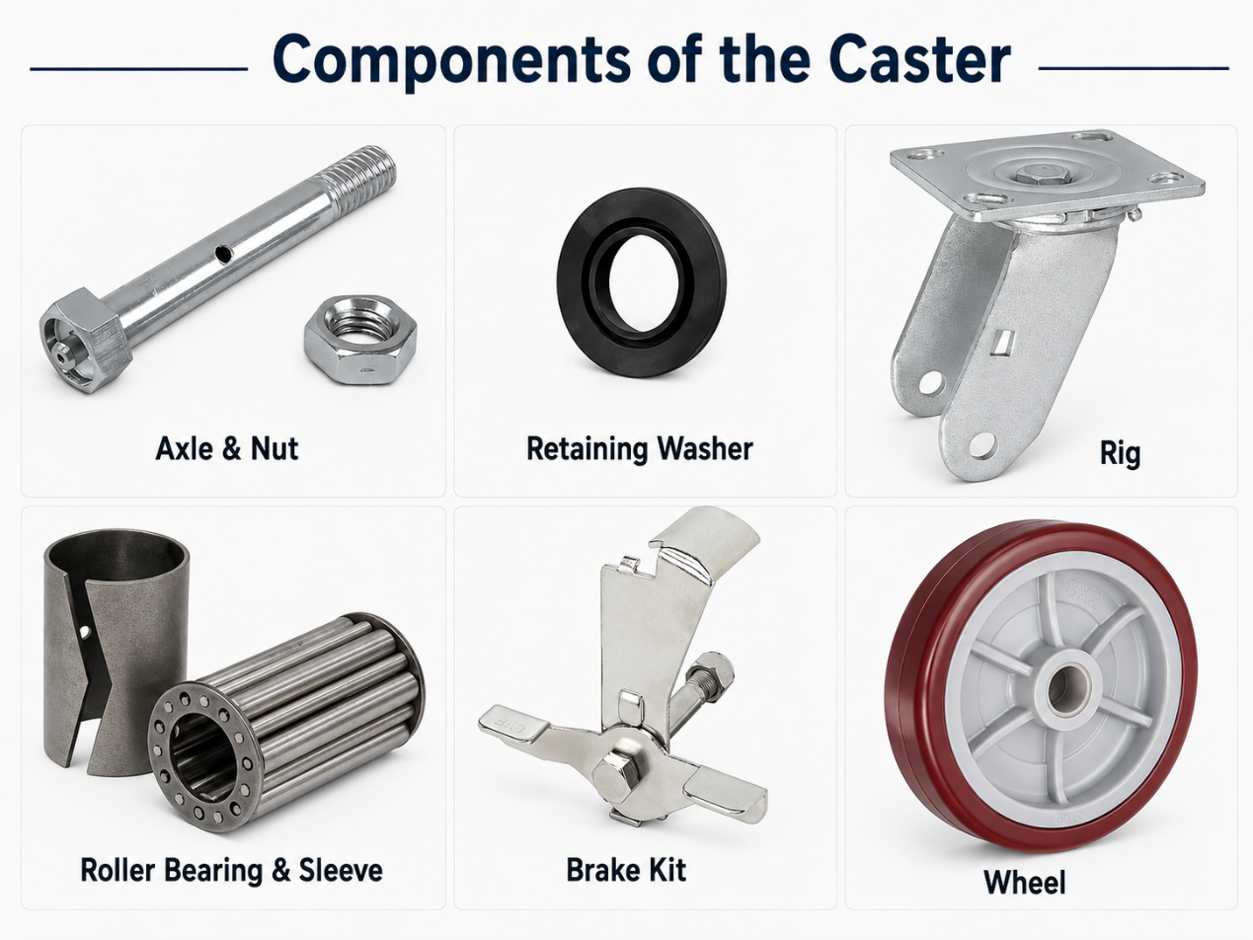
While choosing the right caster for your application there are many parts that complete a caster. Some of these parts are interchangeable to better suit your application, while some are simply industry standard. What does the standard caster consist of? The standard caster consists of a rig, wheel, bearing, axle, nut and commonly a brake.
Parts
Rig / Yoke/ Fork/ Horn- These are some of the most common terms you will hear when talking about the structural metal frame of a caster. This is a loose term used within the caster industry but in general all these terms refer to the metal frame that holds the wheel in place. The rig is the component that is fastened or welded onto the object that is being moved. Rigs are available in various sizes and fastening options and can typically be interchangeable to meet your fastening needs.
Wheels-The wheel is the key component of a caster, which is mounted within the rig and allows objects to be rolled from one location to the next. Wheels are available in numerous sizes and materials and can be interchanged to meet the requirements for your application. Please refer to our wheel material section to learn about the various wheel materials and learn how to pick the best wheel for your application.
Bearing- Bearings are a mechanical component within a caster that reduces friction between parts and enables the shift in direction on swivel rigs and the rotation on wheels. Swivel rigs use ball bearings within a raceway to allow the shift in direction on swivel casters. Raceway ball bearings are an industry standard component that cannot be interchanged, however the bearing within the wheel can be interchanged to meet the requirements of your application. Some of the common factors that impact your choice in bearings may be load capacity, chemical resistance, water, corrosion, high heat and more. Please refer to our bearing options menu to determine the best bearing for your application.
Axle- A bolt that passes through the bore (center hole) of a wheel and or wheels to fasten the wheel to the rig. Depending on the bearing type some axles will pass through a spanner/bushing (Ex: Roller Bearings, Delrin Bearings, Bronze Bearings), while others can pass directly through the bearing (Precision Bearings, Plain Sleeve Bearings, Annular Ball Bearings), and on some smaller casters without bearings the axle will simply go through the plain bore. Some of the various axle types include zerk axles for applications that require grease, flat head axles for casters that do not require grease, stainless steel axles for environments susceptible to corrosion and riveted axles which are typically used on light duty standard industry casters that are built by the manufacturer. While we typically use industry standard axles based on each application we can interchange the axle upon customer request.
Nuts- Nuts are used to fasten the axle that passes through caster rig and wheel. Nuts secure the wheel within the rig to ensure that the wheel is safely in place while allowing the wheel to roll freely. While there are numerous different types of nuts Access Casters chooses the option that best suits your application. Nuts are an interchangeable part but typically we would only change the nut for specialty applications at the customer’s request.
Spanner Bushing- A spanner bushing is a metal or plastic sleeve that sits within the bore of the wheel to provide axle support, structural strength and load distribution. On most applications a spanner busing is placed through the center of a roller bearing to reduce the bore inner diameter to create the perfect fit for an axle. Choosing the correct spanner ensures that the bearing is aligned and the wheel moves straight. Using the wrong size spanner can cause misalignment, wobbliness and can impact the durability and strength of the caster. There are numerous sizes available for spanners, but the primary materials spanners come in are steel, stainless steel or Delrin(plastic). Access Casters will choose the spanner that best suits the customers’ needs, but spanners bushings are absolutely an interchangeable part that can be switched to adapt to your application. Please refer to our spanner section to learn about the various types of spanners and their benefits.
Washers- Washers are small metal, plastic, or rubber disc used to keep bearings and grease within the wheel, while also preventing dirt and debris from getting inside the bearing. There are 3 primary types of washers that can be used on caster which are retaining washers, thrust washers and mounting washers. Retaining washers are pressed onto both sides of the hub to secure the bearing and grease within the wheel. Thrust washers can also be placed on both sides of the hub to reduce friction and movement of the wheel. Thrust washers help manage thrusting while the wheel is turning and reduce wobbliness on the wheel. Mounting washers are used on the stem or top plate of a caster to help evenly distribute the weight and prevent unnecessary moment or damage. While washers are a standard industry component, they are mostly interchanged to meet certain requirements (Ex: A steel washer would be used instead of a plastic washer for high temperature applications)
What is a caster?
A caster is a complete wheel assembly designed to attach to the bottom of a cart, piece of equipment, machine, rack, furniture item, or other object so that the object can support weight while rolling across a surface. Casters allow something that would typically be manually moved (lifted, carried, or dragged) to roll from one location to another.